
Product Talk: Why charging alone won’t power heavy-duty fleet electrification
This month, Ida Mortensen, Product Marketing Manager, sits down with Kasper Thybo, Product Director, and Alex Maciuca, Solution Roll-out Manager, to examine one of the most complex and demanding frontiers in EV charging: electric heavy-duty fleets.

- Heavy-duty fleet operators run on razor-thin margins and depend entirely on predictability - EV charging has to meet that bar.
- Booking, reliability, and uptime aren't nice-to-haves for fleets. They're the business case.
- Spirii's approach is to plug into existing operations rather than replace them - working with the systems operators already trust.
- Understanding the truck driver, not just the truck, is what sets Spirii apart.
“If you're not on time, you're not in business”
To understand what heavy-duty fleet operators need from EV charging, you first have to understand how they think.
“Any business running a fleet is obsessed with Total Cost of Ownership," Kasper explains. "Low margins, tight schedules, expensive vehicles - there’s no room for surprises.”
Alex, who works directly with fleet operators deploying charging infrastructure, puts it even more bluntly: "Your customers depend on predictability. If you're not on time, you're not in business. That pressure doesn’t disappear when a fleet goes electric - it intensifies. The truck might be different, but the business hasn’t changed."
EV charging has to meet that same standard: reliable operations and high uptime are non-negotiable.

The numbers are compelling and so is the opportunity
The economic case for fleet electrification is strong, driven by lower energy costs, reduced maintenance from fewer moving parts, regulatory tailwinds, and savings that operators can model before signing a contract.
"When fleet operators look at the numbers, the savings from switching to EVs are hard to ignore," says Alex. "The data speaks for itself, and it's genuinely exciting.”
The opportunity is clear. What operators need now is the confidence to act on it. That means bridging the gap between a familiar, mature diesel industry and a new EV charging landscape that's still taking shape.
"With fossil fuels, operators know every part of the playbook," Kasper says. "Our job is to make EV's charging feel just as certain – and frankly even more reliable. That's exactly the space Spirii operates in: turning a compelling business case into something operators can feel in their day-to-day".
"It's not just about showing the numbers," Alex adds. "It's about making the whole experience so solid that the decision becomes obvious. That's where the real conversation starts."
Charging isn't the point. Delivering is
One of the biggest mindset shifts in working with heavy-duty fleets is understanding what operators actually care about.
"EV charging isn't the most important thing to a fleet operator," Kasper says. "Reaching the delivery point is. Charging is just what has to happen in between - reliably, predictably, every time."
That's why booking has emerged as one of the most powerful features Spirii can offer fleet customers. Being able to reserve a charger in advance removes one of the biggest unknowns in an electric route.
"Booking is a real differentiator," Kasper says. "It's one of those features that sounds simple but completely changes the conversation with fleet operators.”
The charging industry's fragmentation makes this even more critical. Operators are often navigating multiple networks, roaming agreements, and varying reliability standards across different countries and corridors.
"Geography drives decision-making," Kasper explains. "Logistics companies choose electric routes based on the infrastructure that exists. If the network isn't visible and dependable, they'll stick to diesel routes."

The driver is the missing piece
“Changing driver behaviour is not easy," Alex says. "So instead of asking drivers to adapt to EV charging, we need to make EV charging adapt to them."
That means acknowledging that a truck driver's needs are fundamentally different from those of a passenger-car driver's. Different stopping patterns, different time pressures, different relationships with their vehicles. Spirii's focus on driver-friendly experiences and understanding what happens on the ground helps make the difference.
"We're close to the driver," Kasper says. "That bottom-up understanding is something we take seriously. It shapes everything from how we design features to how we support operators in the field."
Built for the way fleets actually work
When fleet operators move to Spirii, they're not just getting an EV charging platform, they're getting a platform ecosystem designed around the specific demands of their business.
"Booking is probably the feature that lands hardest," Alex says. "When a driver knows a charger is reserved for them, that removes one of the biggest unknowns in an electric route. It turns charging from a risk into a plan.”
That predictability runs through the whole platform. Fleet managers get a clear, centralised view of their chargers and drivers, making it easy to monitor, manage, and act when issues arise.
"We want fleet operators to feel in control," Kasper says. "Simple, intuitive management is a big part of that. It shouldn't take a dedicated team to run your charging infrastructure."
But beyond the product, Kasper and Alex are quick to point to something that doesn't show up in a software feature list: the people behind it.
"We back everything up with real service, by real people," Alex explains. "Service level agreements, driver support, roll-out assistance, partner support - the whole package. When something goes wrong at 3am on a delivery route, there's someone to call."
That people-first philosophy is core to how Spirii approaches fleet customers, not as accounts to onboard, but as operations to support.
"The technology only gets you so far," Kasper says. "What keeps operators loyal is knowing that Spirii shows up. Every time."

Reliability wins the future of fleet electrification
For heavy-duty fleets, the shift to electric isn’t a question of if - it’s a question of when infrastructure and confidence catch up.
“The frontrunners are already moving,” Alex says. “And when they move, others follow. Our job is to make sure that when operators are ready, we’re the partner that makes it work.”
At the core of that shift is trust.
“Reliability is everything in this space,” Kasper says. “If you earn it - through uptime, through booking, through being there when something goes wrong - you become part of how they operate. That’s where you want to be.”
Looking ahead, both Kasper and Alex see something bigger taking shape. As platforms mature and data becomes richer, EV charging won’t just be a cost to manage - it will become a lever to optimise operations.
“TCO is what keeps fleet operators up at night, that’s not going to change. What is changing is our ability to give them real visibility and control - smarter charging, better planning, less waste. That’s where the industry is headed, and it’s what we’re building toward. Because in fleet operations, every delivery matters. And every single charge has to work," says Kasper.
Explore market insights and operate your charging business effectively with our resources.
Related articles

Fleets that go electric usually start with one question: do we have enough power? But once that constraint is solved, another tends to take its place. In my role at Spirii, I work with fleet operators deploying and scaling truck charging, including Daimler Truck on the TruckCharge Network. Below are six questions I see emerging as fleets scale. Each one helps explain why the right charging setup today might not be the right one tomorrow.
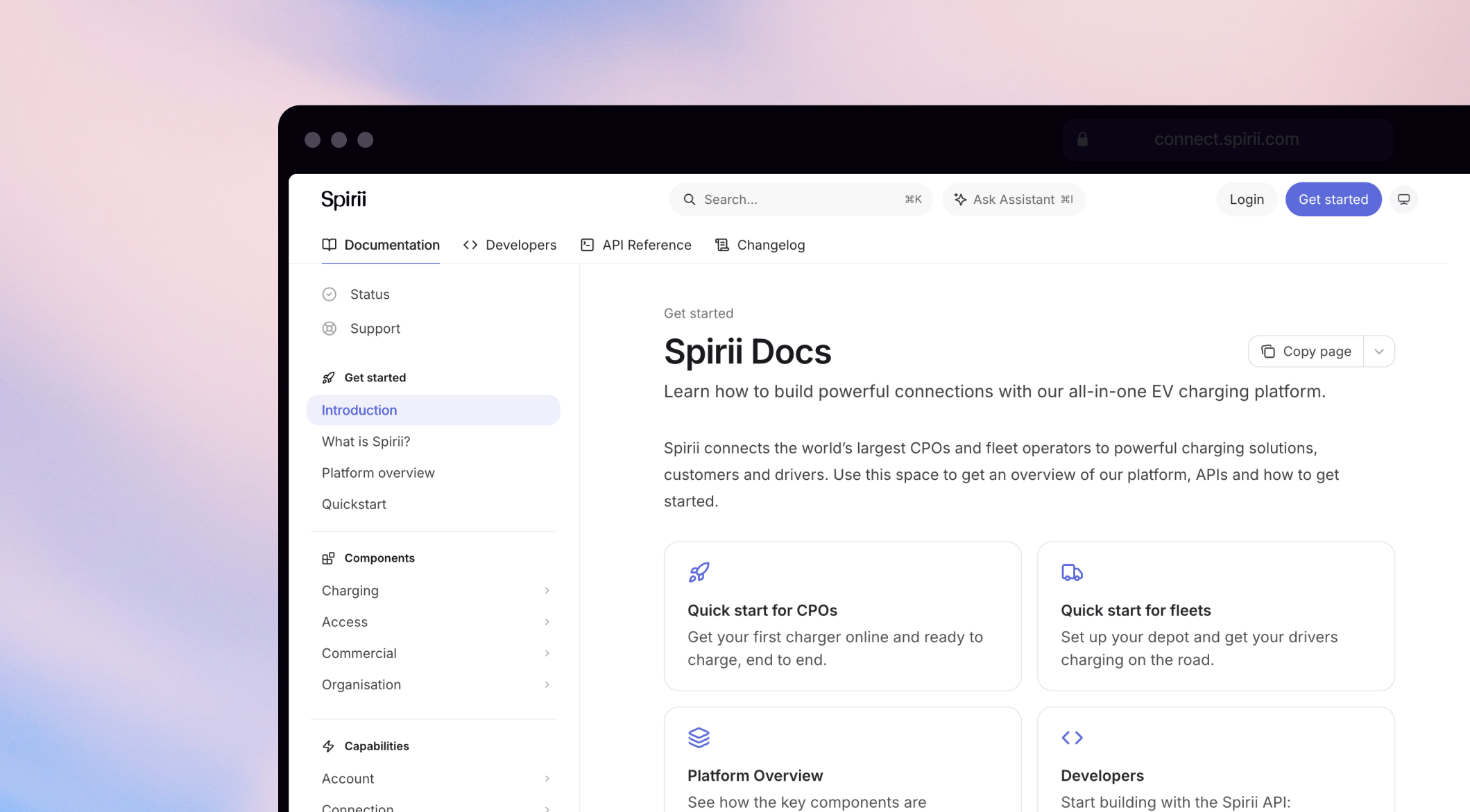
We just launched Spirii Docs, a single home for everything you need to know about Spirii's platform and our public APIs.

Planning an EV road trip across Europe? Heading for a family visit in another city? Or simply want the freedom to charge wherever you go? That's where roaming comes in – and it's easier than you might think. In this video series, Ania, Product Manager at Spirii, shares her expertise and answers some of the most common questions about EV roaming.