
Six questions electric truck fleets face as they scale
Fleets that go electric usually start with one question: do we have enough power? But once that constraint is solved, another tends to take its place. In my role at Spirii, I work with fleet operators deploying and scaling truck charging, including Daimler Truck on the TruckCharge Network. Below are six questions I see emerging as fleets scale. Each one helps explain why the right charging setup today might not be the right one tomorrow.

- The main constraint moves as a fleet scales, through power, operations, accountability, replication, economics and strategy, in an order that differs from fleet to fleet.
- At depot scale, the aim is vehicle readiness – every truck with the energy it needs by its departure time, at the lowest cost the schedule allows.
- Operational accountability matters more than component uptime, because every component can work as specified while a truck still isn't ready, so service levels and escalation paths need defining early.
- International fleets need a common operating model that standardises data, reporting, integrations and incident workflows while hardware, energy contracts and compliance adapt locally.
- Idle chargers can earn income if opening the depot never affects the reliability of the fleet's own operation.
- For build versus buy, own what encodes how the business runs and buy what is becoming industry standard.
By Alex Maciuca, Solution Roll-out Manager at Spirii.
The constraint keeps moving
In my conversations with fleet operators, many describe the same experience: they solve the problem they have planned for, and soon afterwards a different one takes its place.
A fleet that has fought for a larger grid connection soon finds that the connection is no longer the issue; the question has become how to share the available power between trucks with different departure times and routes. A fleet that has mastered load management at one depot discovers that the know-how sits with a handful of people and does not carry over to the next site, in another country, with a different grid operator and different metering rules. Each answer was right when it was given, and each one shaped the problem that followed.
Taken together, those conversations suggest that the constraint on fleet electrification moves through six areas:
- Power: whether the site has enough of it.
- Operations: how to make the most of the power that is available.
- Accountability: who is responsible when charging, energy and fleet operations collide.
- Replication: how to repeat a working model across depots, countries and regulatory regimes.
- Economics: how to get more value from an expensive asset.
- Strategy: what to own and what to leave to specialists.
If you’re familiar with Goldratt's Theory of Constraints, you will recognise the pattern: relieving a system's bottleneck does not remove it but moves it somewhere else. In fleet electrification this has a practical consequence: a charging setup designed around one constraint can become an obstacle once the constraint has moved on, because the decisions that solved the earlier problem, from hardware and energy contracts to who in the organisation owns charging, are already locked in when the next one arrives.
The order in which these six constraints appear differs from fleet to fleet, and they frequently overlap. What holds across every conversation I have had is that the right answer to one constraint needs revisiting when the next one arrives, and that revisiting becomes more expensive the longer a fleet waits.
1. Power: how do we scale charging when the grid can't scale with us?
With a handful of electric trucks, it's natural to plan charging around hardware: how many chargers, where to put them and how fast they should be.
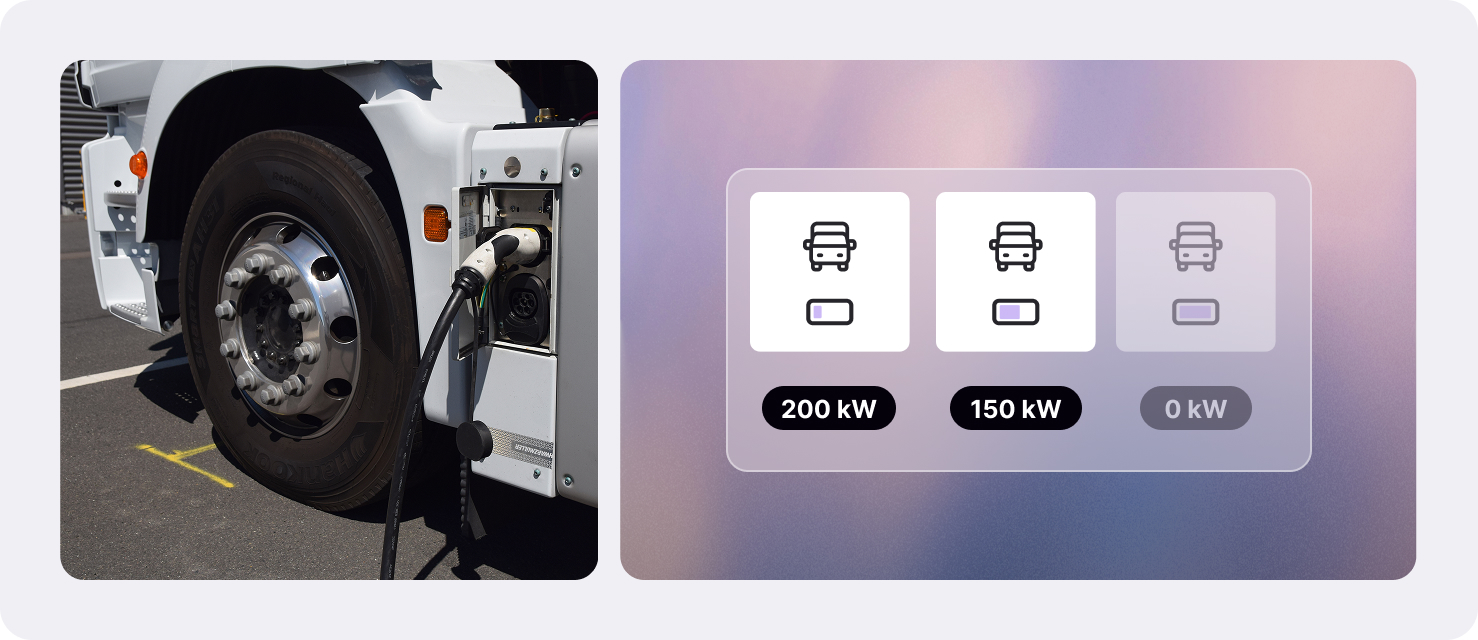
With 50 trucks, the binding factor is usually how much power the site has and how intelligently it is allocated. A depot of that size does not need 50 chargers running at full power at the same time. It needs each truck to receive the right amount of energy at the right moment, within the limits of the grid connection.
Allocation then depends on departure times, state of charge, route length, dwell time, other loads on site and energy prices. Take two trucks arriving with the same state of charge, one leaving in eight hours for a short route and the other in two hours for a long one. A system that charges them identically is balancing load rather than managing a fleet.
The objective is vehicle readiness, with charger utilisation and peak charging power as means to that end rather than measures of success on their own. Once the goal is set this way, software, load management, storage and grid capacity stop being separate purchasing decisions and become one design problem.

2. Operations: are we optimising for cheap power or ready trucks?
This looks like an energy question, but in practice it is an operational one.
The cheapest hour to charge isn’t necessarily the right hour to charge. An algorithm optimising purely for price may defer charging to a cheaper window that opens after the truck has already left, so the fleet saves a few cents per kWh and loses a departure in the process. Charging everything on arrival guarantees readiness, but creates avoidable peaks and higher bills.
The useful formulation is a constrained one: find the lowest-cost charging plan that still delivers every vehicle's required energy by its departure time. Price is the variable to optimise, and readiness is the constraint that can’t be traded away.
That formulation needs data the charger does not have: departure schedules, route energy, vehicle availability and target state of charge. This is the point at which electrification stops being an infrastructure project and becomes an operations optimisation problem.

3. Accountability: when a truck isn't ready, who gets the call?
Picture a truck that is not ready for departure, even though the charger reports that it was available, the charging platform confirms that the session started and the energy management system shows that the site stayed within its power limit. Which party should the fleet call: the charger manufacturer, the charging platform, the vehicle OEM, the energy management provider, or its own IT team?
We recently handled a much simpler version of this. In the middle of the night, a driver at a home depot tapped an RFID card to start charging, and nothing happened. Only two parties were involved, the CPMS and the charger manufacturer, yet the driver had no way of knowing whose hotline could help at that hour. The driver called the fleet's own operations team, and the case was escalated to us the following day. Thanks to a resourceful and competent fleet operations team, no revenue was lost.
That incident involved two actors, at a home depot, with the fleet's own trucks. The ambitions of fleet electrification now point towards shared depots, visiting vehicles and ecosystems of many interconnected systems. In that setting, if accountability lines are not clearly drawn and clearly communicated, the same failed card tap turns into a chain of calls in which every party can show that its own component worked and nobody can get the truck charged.
The distinction that matters is between component responsibility and operational accountability. A charger provider can fairly be held to charger uptime, but the fleet measures something else: was the vehicle ready when the operation needed it? Every component can meet its own service level while the answer to that question is still no.
Service levels, escalation paths and system ownership therefore need to be defined before the setup becomes too complex to untangle. A simple test: if a truck cannot leave tomorrow morning because it did not charge tonight, do you know who owns the problem and who has the authority to fix it?

4. Replication: how do we scale across depots without creating multiple charging operations?
What works at one depot rarely transfers unchanged to the next. Grid connection processes, electricity markets, metering rules and commercial incentives all vary. Germany's calibration law (Eichrecht), for instance, imposes metering requirements on kWh-based billing that a depot elsewhere may not encounter, and it becomes relevant the moment a German site starts charging third parties.
An international fleet is caught between two pressures: standardisation and flexibility. The former keeps cost and complexity under control, since a different technology stack at every site becomes expensive very quickly. The latter is unavoidable, because the infrastructure and the rules underneath it are not the same.
The answer is a common operating model with deliberately defined local variation. The layers that should be identical everywhere are data models, reporting, integrations and incident workflows: they are what allow a central team to compare sites and act on what it sees. The layers that should flex are hardware choice, energy contracts and compliance set-up, because local conditions dictate them anyway. Making that split explicit early, and writing it down, saves every new depot from renegotiating it from scratch.

5. Economics: how do we get more value from idle chargers?
Charging infrastructure is first and foremost an operational asset whose job is to keep your trucks working. But trucks do not charge around the clock, and at many depots a large share of installed capacity sits unused for long stretches.
That invites an obvious question: could someone else use it? Another fleet could charge overnight, the depot could join a wider heavy-duty charging network, and the chargers could earn revenue instead of remaining a pure cost centre.
Each of these options can turn idle capacity into income, but every step also adds a new way for things to go wrong for your own fleet first: who gets access, how sessions are billed, whether a visiting truck is even compatible with your setup. Opening the depot only pays off if your own trucks never notice it happened.
The commercial question is therefore narrower and harder than raising utilisation: it is how to raise utilisation without making your own operation any less reliable.

6. Strategy: what should we own, and what should we leave to specialists?
This question tends to surface once a fleet has seen how quickly the technology stack moves.
Building in-house is attractive at first: control, flexibility, a system shaped around your own operation. But the real cost of building lies less in the initial development than in staying responsible for everything that follows. New truck models, new chargers, protocol updates, new markets, tighter cybersecurity requirements and changes to your own operating model all arrive on their own schedule, rarely a convenient one.
Outsourcing everything carries the opposite risk: handing control of an operationally critical system to a party whose priorities are not yours.
A workable criterion is to separate what differentiates your operation from what is converging into an industry standard.
Own what encodes how your business runs: dispatch and departure logic, the rules that define when a truck counts as ready, and the operational data that connects charging to routes, drivers and customers. Outsiders find these hard to specify, and they are where your advantage sits.
Buy what is becoming industry plumbing: charger and vehicle integrations, protocol support, firmware and certificate management, market-specific compliance. Every fleet needs them, they change constantly, and maintaining them yourself means paying for work that gives you no edge.
The line will fall in different places for different fleets, and it shifts as standards mature, which is precisely why it belongs in strategy rather than procurement.
The question to keep asking
Success in electrification does not remove constraints; it relocates them.
First you need enough power, then you need to manage it. Then you need to connect charging to the operation and settle who owns the outcome, repeat the model across sites and markets, and finally make expensive infrastructure work harder.
The sequence will look different for every fleet, but the practical lesson holds. It is worth asking not only what constrains your electrification today but what will constrain it next, because the biggest risk at scale is solving today's charging problem so narrowly that it creates tomorrow's.
Explore market insights and operate your charging business effectively with our resources.
Related articles
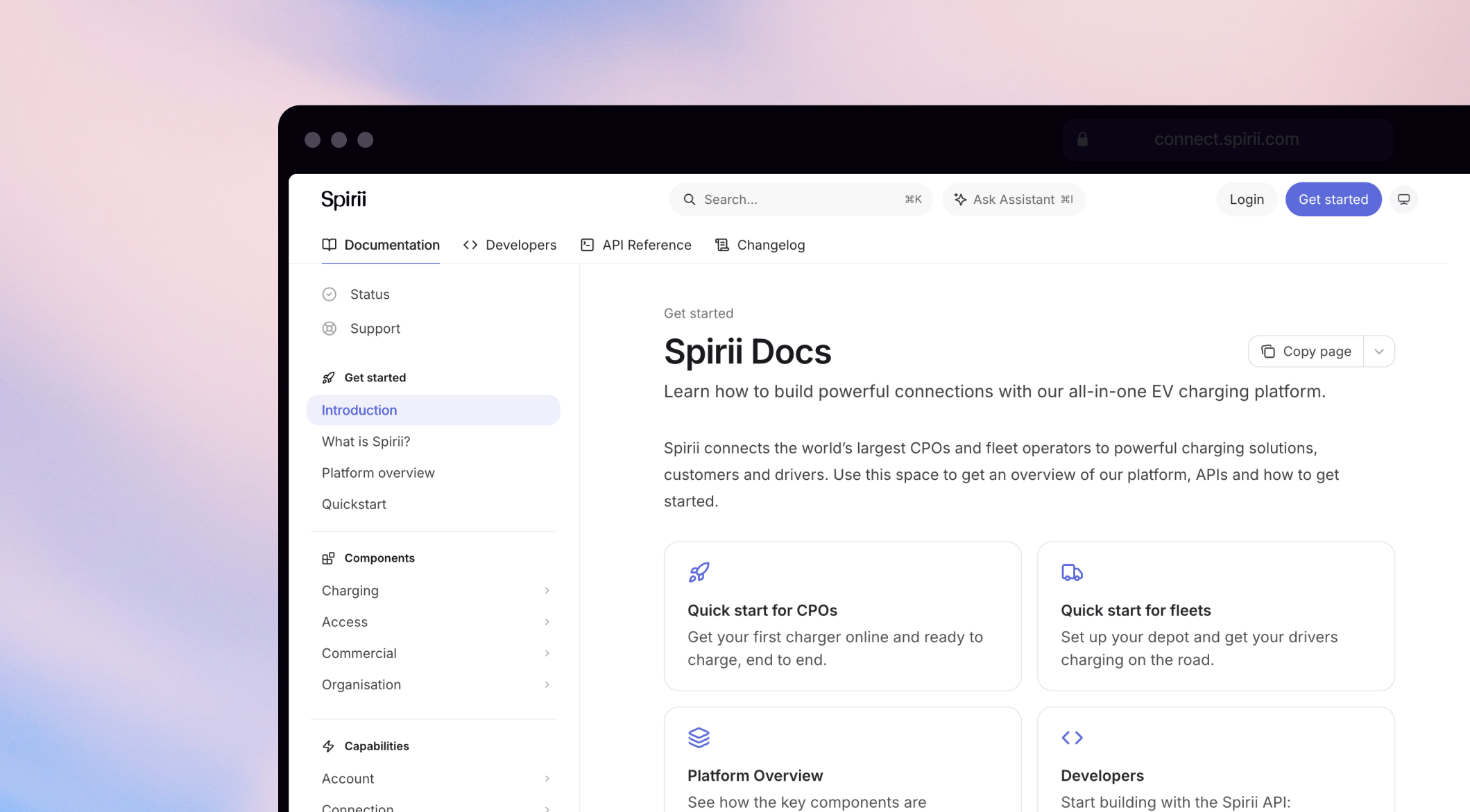
We just launched Spirii Docs, a single home for everything you need to know about Spirii's platform and our public APIs.

Planning an EV road trip across Europe? Heading for a family visit in another city? Or simply want the freedom to charge wherever you go? That's where roaming comes in – and it's easier than you might think. In this video series, Ania, Product Manager at Spirii, shares her expertise and answers some of the most common questions about EV roaming.

This month, Ida Mortensen, Product Marketing Manager, sits down with Kasper Thybo, Product Director, and Alex Maciuca, Solution Roll-out Manager, to examine one of the most complex and demanding frontiers in EV charging: electric heavy-duty fleets.